In hiding and then ignored
For months after they landed in Australia, the female players kept their whereabouts a secret while they were living in temporary accommodation as they still feared for their safety.
The local cricket clubs they joined also helped protect their identities.
They waited until December 2022 and then wrote to the ICC to tell them they were living in Australia and to ask two big questions: what had happened to their contracts with the ACB and what had happened to the money that goes to the ACB that should be for their development?
They also requested that some of those funds be redirected to the players in Australia.
After a month, the ICC replied to say that contracts were a matter for the ACB and that it was up to the board to decide how to spend the funds it receives from the global governing body.
But with the ACB refusing to engage with their female players, the team were left feeling like those at the top of sport had washed their hands of them.
In June 2024, in light of Afghanistan’s men’s team reaching the semi-finals of the T20 World Cup, the women seized their moment to write a second letter to the ICC.
This time they asked to be allowed to form a refugee international team.
They say they have never received a response to that letter.
“It’s so painful and so disappointing,” said Shabnam Ahsan, who was just 14 when she fled her country. “I don’t understand why they [the ICC] are not doing anything to help us. We have worked so hard and we deserve help just like every other team.”
The ICC told BBC Sport in a statement it “remains engaged with the situation in Afghanistan, with the wellbeing and opportunities of players as our top priority”.
Its chair Jay Shah added: “We are committed to supporting cricket development through the Afghanistan Cricket Board while recognising the challenges facing Afghan women’s cricket, including the concerns of players living in exile.
“The ICC is also reviewing certain communications concerning Afghanistan women’s cricket and exploring how they can be supported within ICC’s legal and constitutional framework. Our focus is on constructive dialogue and viable solutions that safeguard the best interests of all Afghan cricketers.”
Boycott calls and ‘gender apartheid’

Firooza Amiri (second from left) and her team-mates played their first match as the Afghanistan Women’s XI last month
Records show Afghanistan had a women’s cricket team in 2012 which folded shortly afterwards. It was then officially relaunched in 2020 when a talent camp led to 25 players being given contacts.
Having a women’s team is part of the criteria required for a country to become a full ICC member and it means Afghanistan receives full funding and Test status.
Yet despite no longer having a women’s team, the ACB still enjoys that full membership, a fact that has started to raise eyebrows around the world.
Earlier this year, UK politicians wrote to the England and Wales Cricket Board (ECB) calling for England’s men to boycott their Champions Trophy match against Afghanistan on 26 February in protest at the treatment of Afghan women.
The ECB refused but called on the ICC to act, with chief executive Richard Gould writing to the global governing body to take action after what he called “gender apartheid”.
He also called for Afghanistan’s funding to be withheld until women’s cricket is reinstated and support given to Afghan women’s players.
Amiri said she and her team-mates are “proud” of the Afghanistan’s men’s side. All they want is to be treated on the same terms.
“The ICC celebrates equality, but I don’t know what equality they’re celebrating,” Amiri said. “Afghanistan doesn’t have a women’s team and they are still giving the men’s team the chance to play and funds.
“I am so angry. The ICC has never done anything for us. We just want to have a team to give hope to the millions of women in Afghanistan.”
ICC chief Shah said: “Although we continue to support the ACB, we acknowledge the absence of a women’s programme and are actively addressing this through the Afghanistan Cricket Task Force, led by deputy chairman Mr Imran Khwaja.”
As a result of this lack of recognition as a national team, the women had to play as an Afghanistan Women’s XI – rather than officially as Afghanistan – when they faced a Cricket Without Borders side in Melbourne last month.
‘We don’t want this to be our first and last game’
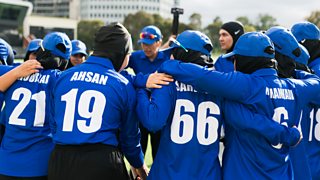
‘Just don’t give up’: An Afghanistan Women’s XI play first match in Australia
Stepping out at the Junction Oval, which a few days earlier had hosted a Women’s Ashes match between Australia and England, the players sported a custom-made kit that featured a badge they had designed themselves.
The logo depicted a red tulip and a golden wattle – the national flowers of Australia and Afghanistan – entwined around a cricket ball.
It was a sign of how much they have embraced their new life down under, where many of the players now study or work.
The players lost the 20-over exhibition match with four balls to go. But the true victory was the game itself taking place.
“It was so good,” bowler Nilab Stanikzai said. “We are so happy to finally play together.
“We hope it pushes the ICC to support us. To the people in the high positions, please help us.”
Nahida Sapan, who captained the side on the day, added: “We don’t want this to be our first and last game. We want to play a lot, we want to achieve our dream.”
And team-mate Shazia Zazai said: “We’re doing this for all Afghan women. To tell them to be proud of themselves and that they are the strongest women in the world. Please don’t give up.”
It was a day full of emotion and sheer joy but an important question remains: what’s next for the team?
They have no official funding, although an online fund called Pitch Our Future was launched the day after their match and aims to raise £750,000 to help secure the team’s future.
The Marylebone Cricket Club Foundation UK has also pledged that Afghanistan’s women players will be the first beneficiaries of their new Global Refugee Cricket Fund.
The players still have big dreams to one day play on the international stage, but that depends on whether the ICC engages with them.
However, one thing is certain: at a time when women in Afghanistan feel they have no voice, this team will not be silenced.